
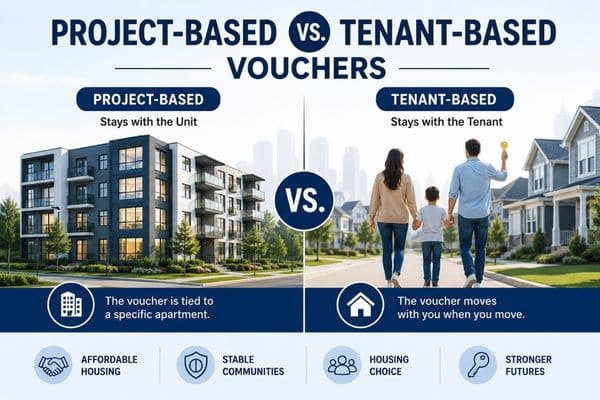
A Tenant-Based Voucher (TBV) moves with the person, giving renters the freedom to choose where they live. A Project-Based Voucher (PBV) stays attached to a specific unit, giving property owners long-term subsidy certainty. Both are federally funded under HUD’s Housing Choice Voucher program, and both serve millions of Americans navigating the rental market today.
One of the most common questions surrounding the Housing Choice Voucher Program is the difference between project-based vouchers and tenant-based vouchers.
Although both forms of assistance operate under HUD’s Housing Choice Voucher Program, they work in very different ways and offer distinct advantages depending on a household’s needs.
What is the difference between a project-based voucher and a tenant-based voucher?
What Is the Housing Choice Voucher Program?
The Housing Choice Voucher (HCV) Program helps low-income families, seniors, and people with disabilities afford housing in the private rental market. In most cases, households contribute roughly 30% of their monthly income toward rent and utilities, while the government pays the remaining approved amount directly to the landlord.
At its core, the program is designed to expand access to safe, decent, and affordable housing. Depending on the type of assistance, it can also give households greater flexibility to live in neighborhoods with better schools, employment opportunities, and community resources.
Within the Housing Choice Voucher program, there are two distinct forms of assistance. One follows the household. The other follows the housing unit.
What Is a Tenant-Based Voucher?
A Tenant-Based Voucher (TBV) is rental assistance tied to the household, not to any specific apartment or building.
Think of it like a discount card you carry in your wallet. Your local PHA gives it to you, and you take it into the private rental market to use at whatever qualifying unit you find. Once you and the landlord agree on a lease, the PHA pays their share directly to the landlord. You pay roughly 30% of your adjusted monthly income.If you’re wondering how your portion of the rent is determined, here’s a guide explaining how Section 8 rent is calculated.
The primary advantage of tenant-based vouchers is flexibility and housing choice. You decide where you live. Want to be near your job? Better schools? A quieter block? Your assistance follows you there. And when your lease ends, the voucher moves with you to whatever comes next.
This is what most people picture when they hear “Section 8” and it’s the most common form of HCV assistance.
How Does a Tenant-Based Voucher Work?
Here’s what the process looks like, step by step:
1. Apply to your local PHA and join the waiting list
2. Receive your voucher with a search window typically 60 to 120 days
3. Find a unit in the private market that meets HUD’s Housing Quality Standards (HQS) and falls within the local payment standard
4. PHA inspects and approves the unit, then starts paying the landlord directly
5. You pay your share approximately 30% of your adjusted monthly income toward rent and utilities
6. Annual recertification your income is reviewed each year and your contribution is updated
When you’re ready to move at lease end, you take the voucher with you and repeat steps 3–5 wherever you land next.
Benefits of Tenant-Based Vouchers
| Benefit | Why It Matters |
| Freedom to Move | You’re not locked into any specific building, neighborhood, or landlord, giving you greater flexibility when your housing needs change. |
| Portability | After 12 months in a PHA’s jurisdiction, you can transfer your voucher to another city or state. Learn more about how to transfer your Section 8 voucher if you’re planning a move. |
| Neighborhood Choice | Because the assistance follows the household rather than the unit, tenant-based rental assistance can help families access higher-opportunity neighborhoods with better schools, employment opportunities, and community resources. |
| Protection if the Building Is Sold | The voucher travels with you rather than staying with the property, providing added security if ownership changes. |
| Proven Long-Term Outcomes | HUD’s Moving to Opportunity research found that families who move to lower-poverty neighborhoods through voucher programs often experience improved long-term earnings, better health outcomes, and stronger educational opportunities for children. |
Drawbacks of Tenant-Based Vouchers
- Landlord participation issues — not every landlord accepts vouchers; participation rates vary significantly by city and market. Knowing where to look can help. Here’s how to find landlords who accept Section 8 vouchers.
- Voucher expiration risk — if you can’t find a qualifying unit within the 60–120 day window, you can lose the voucher and return to the waitlist
- Tight market challenges — in high-cost cities, finding a unit that falls within the local payment standard is genuinely difficult
- Source-of-income discrimination — while illegal in many states, some landlords still refuse voucher holders; legal protections vary by jurisdiction
What Is a Project-Based Voucher?
A Project-Based Voucher (PBV) is rental assistance tied to a specific housing unit , not to the tenant living in it.
Instead of a tenant bringing a voucher into the open market, the PHA signs a long-term contract with a property owner, typically 15 to 20 years, with renewal options up to 20 additional years to reserve a set number of units for income-qualified households. The subsidy lives in the apartment. When you move in, you benefit from it. When you move out, it stays behind for the next eligible resident.
As defined under federal regulation (24 CFR Part 983), project-based assistance is “attached to the structure.” That single distinction changes nearly everything about how the program works in practice, for tenants, for property owners, and for the housing market overall.
As of 2025, there are nearly 330,000 PBV units under active HAP contracts across the country, and that number has grown substantially through HUD’s Rental Assistance Demonstration (RAD) program, which converts public housing to long-term PBV contracts.
How Does a Project-Based Voucher Work?
| Step | What Happens |
| PHA Signs a Contract | The Public Housing Authority (PHA) selects a property owner and enters into a Housing Assistance Payment (HAP) contract. |
| Units Are Reserved | A set number of apartments in the building are designated for households eligible for Project-Based Vouchers (PBVs). |
| You Apply | Applicants can apply directly to the property or receive a referral from the PHA’s general waiting list. |
| You Move In | Once selected, you move into the unit, pay roughly 30% of your income toward rent, and the PHA pays the remaining approved amount to the landlord. |
| After 12 Months | After living in the unit for one year, you may request a Tenant-Based Voucher from your PHA if one is available, giving you the option to move while keeping rental assistance. |
If you leave before 12 months, the rental assistance stays with the unit, not with you.
Benefits of Project-Based Vouchers
| Benefit | Why It Matters |
| No Open-Market Search Required | The unit already participates in the program, so you don’t have to spend time searching for a landlord willing to accept vouchers. |
| No Expiration Clock | You don’t risk losing your assistance because you couldn’t find a qualifying unit within a limited search period. |
| Predictable Rent | Your share of the rent generally remains around 30% of your income, even if market rents in the building increase. |
| Strong Eviction Protections | Landlords must have a valid reason, or “good cause,” to terminate your lease and cannot simply refuse to renew it. |
| Protection if the Building Changes Ownership | If the property is sold, the Housing Assistance Payment (HAP) contract transfers to the new owner, and your housing protections remain in place. |
| Access to Support Services | Many Project-Based Voucher properties offer case management, healthcare coordination, and other services, making them especially helpful for seniors, veterans, and people with disabilities. |
Drawbacks of Project-Based Vouchers
- No portability before 12 months: moving out before the 12-month mark means losing your rental assistance entirely
- Limited neighborhood choice: you live where the PBV building is located; you don’t pick the neighborhood
- Dependent on property conditions: if building management declines, your options are limited while you remain in the unit
- Concentration risk: poorly sited PBV developments can concentrate poverty if not located in opportunity-rich areas
Project-Based vs. Tenant-Based Vouchers: Key Differences
| Feature | Tenant-Based Voucher (TBV) | Project-Based Voucher (PBV) |
| Assistance follows | The household | The housing unit |
| Can you choose your apartment? | Yes | No |
| Can you move and keep assistance? | Yes, at the end of a lease | After 12 months, if a TBV is available |
| Housing search required? | Yes | No |
| Search window | Typically 60–120 days | No expiration clock |
| Portability to another city or state | Yes, after meeting HUD requirements | Limited |
| HAP contract | None | 15–20 years, with renewal options |
| Eviction protections | Standard lease laws | Good-cause protections under federal rules |
| Neighborhood choice | High | Limited to the property’s location |
| Risk of losing assistance | If no qualifying unit is found within the search period | If you leave before 12 months |
| Best for | Families and individuals seeking flexibility and mobility | People seeking stable, immediate housing |
| Common users | Working families and households want choice | Seniors, veterans, people with disabilities, and supportive housing residents |
| Current scale nationwide | The majority of the 2.3 million HCV households | Approximately 330,000 units under active HAP contracts |
| Main advantage | Freedom to choose where you live | Faster placement and long-term stability |
| Main drawback | Finding a landlord who accepts vouchers can be challenging | Assistance stays with the unit |
Who Qualifies for Housing Choice Vouchers?
Both TBVs and PBVs draw from the same eligibility pool. Here’s what the current rules require:
-
Income Limits
Your total household income must generally be at or below 50% of the Area Median Income (AMI) for your area. But in practice, federal law requires that at least 75% of new voucher admissions go to households at or below 30% of AMI — meaning the lowest-income families get priority access.
Income limits vary by county, metro area, and household size, and are updated by HUD annually. In the Baltimore and Maryland region, eligibility thresholds shift each year — your local PHA can give you the current figures.
-
Household Size
Your voucher size and subsidy amount are tied to your household composition. A larger family qualifies for a larger unit and higher assistance. Any changes to who lives in your household must be reported to the PHA and may affect your voucher size or payment.
-
Citizenship Requirements
At least one household member must be a U.S. citizen or eligible non-citizen (such as a lawful permanent resident) to receive assistance. Mixed-status families may receive prorated assistance based on the number of eligible members. (Source: HUD)
-
Criminal Background
PHAs are permitted to screen applicants based on criminal history. Certain convictions — including lifetime sex offender registration and some drug-related convictions, can result in mandatory denial. Each PHA has its own screening standards beyond those minimums. Ask your local PHA for their specific policy before applying.
-
Asset Limits — Updated 2024
Under the 2024 HOTMA Final Rule (effective June 2024), households with net assets over $100,000 (adjusted annually for inflation) or those who own a livable home may no longer qualify for assistance. This was a significant change from prior policy,if you hold significant savings, investment accounts, or property, speak with your PHA before applying.
-
Local PHA Rules
Every PHA sets additional criteria within HUD’s framework — including local residency preferences, priority populations, and admissions policies. Always check directly with your local housing authority. Avoiding common mistakes can also help prevent delays. Here are some of the most common Section 8 application errors applicants make.
Who typically gets priority?
Most PHAs give preference to:
- Families and individuals experiencing homelessness
- Veterans (through HUD-VASH)
- People with disabilities (Mainstream Vouchers — $743 million funded in FY 2025)
- Victims of domestic violence, dating violence, or stalking
- Families are being displaced from public housing through RAD conversions
Which Voucher Gets You Housed Faster?
This is one of the most common questions applicants ask, and the answer largely depends on local availability and housing market conditions.
With a tenant-based voucher, you hold the assistance, but you have to find a willing landlord in a ticking time window. In tight markets, that’s harder than it sounds. In some counties, average rents are already 1.3 to 1.6 times higher than the average monthly income of voucher holders — meaning the payment standard may not stretch far enough in neighborhoods where you want to live.
With a project-based unit, you skip the search entirely. You apply to the property, wait for a vacancy, and when it’s your turn, you move in. No landlord negotiations, no expiration clock.
For many households, pursuing both options simultaneously can increase the chances of securing housing more quickly.
If you’re actively searching for housing, exploring available Section 8 homes and apartments can help you identify opportunities more quickly. Most PHAs allow you to be on the general HCV waitlist and on individual PBV property waitlists at the same time. Being selected from one doesn’t disqualify you from the other. PBV waitlists are often shorter, and applying directly to specific properties can get you housed significantly faster than waiting for a tenant-based voucher alone.
Contact your local PHA and ask specifically which buildings in your area hold active PBV HAP contracts and whether those properties currently have open waitlists.
What Changed in 2025–2026: The Latest Updates
These recent updates may provide several benefits for tenants:
- PHAs must clearly tell PBV tenants about their right to move with a tenant-based voucher after 12 months. This is now mandatory at briefing
- PBV property-level waitlists now have clearer transparency and management requirements
- Payment standards can now better reflect neighborhood-level rents (Small Area FMRs), potentially opening doors to higher-cost areas
- PHA briefings must be accessible to households with limited English proficiency
Frequently Asked Questions
-
What is the difference between a tenant-based voucher and a project-based voucher?A tenant-based voucher stays with the renter and can usually be used when moving.
A project-based voucher stays with a specific housing unit and does not move with the tenant.
-
Who qualifies for a Section 8 Housing Choice Voucher?
Most households must earn 50% or less of the local Area Median Income (AMI). Eligibility also depends on household size, immigration status, and local housing authority rules.
-
How long is the Section 8 waiting list?
Waiting times vary by location. Some areas have waits of several months, while others can take years due to high demand and limited funding.
-
How much rent do you pay with a housing voucher?
Most voucher holders pay about 30% of their adjusted monthly income toward rent and utilities. The housing authority pays the remaining approved amount.
-
Can you move to another city with a Section 8 voucher?
Yes. Tenant-based vouchers are portable and can often be transferred to another city or state after meeting local program requirements.
Final Thoughts
For many households, applying to both tenant-based and project-based programs can improve the chances of securing housing more quickly. Because these are separate processes, participating in one does not prevent you from pursuing the other. Understanding how each program works can help families make informed decisions and improve access to stable, affordable housing.
At The Mt. Washington Group, we understand the importance of stable and affordable housing. Through our professionally managed residential communities, we are committed to supporting quality housing opportunities and helping residents better understand the programs and resources available to them.