
Picture a Tuesday morning. Half your team is at home, two people are in a borrowed conference room, and a client is asking whether you can meet this afternoon. Nobody can say for sure where “the office” is anymore.
That blur is the real problem behind the hybrid work debate. The question for most Baltimore business owners is no longer “office or no office.” It is “how much office, what kind, and for whom?”
This guide gives you a practical way to answer that, with a five-question test, a side-by-side comparison, and a checklist to use before you sign anything.
Quick Answer: Which Office Setup Fits a Baltimore Business?
If you need a fast answer, start here:
- Choose a traditional office if most of your team works in person four or five days a week, you handle confidential client information, or you host frequent face-to-face meetings.
- Choose a hybrid workspace if your team splits time between home and the office, client meetings mostly happen online, and you need a workspace that accommodates changing attendance.
- Choose a middle path (a small private office plus a few dedicated desks) if some roles need to be on site and others do not.
Some businesses find that a middle-ground arrangement offers a practical balance between dedicated office space and remote work. The test below can help you decide whether this approach suits your team.
The 5-Question Office Test for Baltimore Businesses
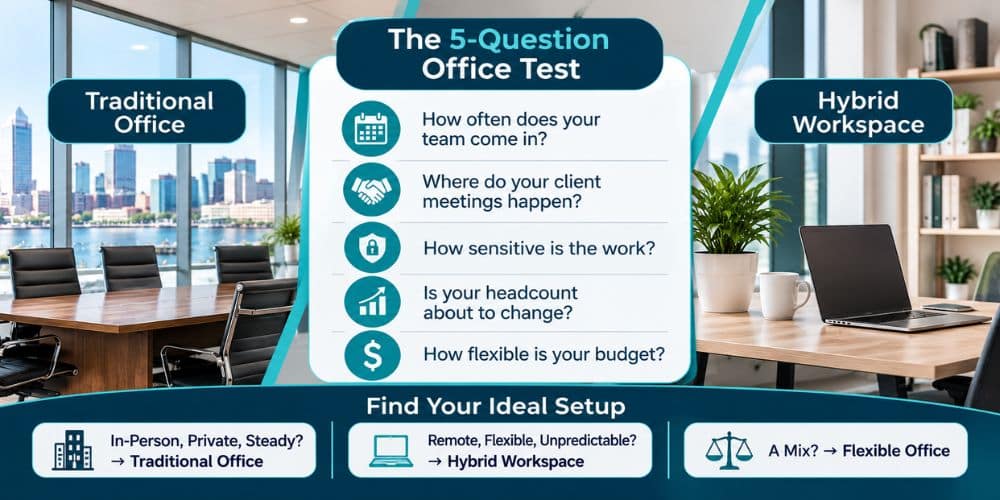
Answer these honestly, and the right setup usually becomes obvious.
1. How many days a week does your team really come in?
Look at actual badge-ins, calendar bookings, or sign-in sheets, not the policy on paper. If most employees are in the office four days or more, a traditional layout may be suitable. If your busiest day has six people and your quietest has one, you may be paying for workspace that is not regularly used.
2. Where do your client meetings happen?
Clients who expect to visit in person need a professional, private room. Clients who are happy with video calls do not. If meetings are mixed, a smaller office with one good meeting room often beats a large floor plan.
3. How sensitive is the work?
Financial records, personnel discussions, legal paperwork, and client consultations are hard to handle at a kitchen table or a shared coffee shop. If confidentiality matters daily, a private office space in Baltimore is worth prioritizing.
4. Is your headcount about to change?
A team that will double in a year needs a different lease than one that has been steady for five. Growth plans should shape both the size of the space and the length of the lease.
5. How much commitment can your budget carry?
Rent is only part of the picture. Deposits, utilities, maintenance, and parking can add to the total cost. If cash flow is tight or uncertain, lease flexibility and predictable expenses may be more important than the lowest monthly rent.
How to read your answers: mostly “in person, private, steady” points to a traditional office. Mostly “remote, online, unpredictable” points to a hybrid or flexible arrangement. A mix points to the middle path.
Traditional Office vs Hybrid Workspace: Cost, Flexibility, and Privacy Compared
Here is how the two approaches stack up on the factors that usually decide the question.
| Factor | Traditional Office | Hybrid Workspace |
|---|---|---|
| Space planned around | Full headcount | Peak attendance days |
| Privacy for sensitive work | High, with dedicated rooms | Varies by setup |
| Cost behavior | Depends on size, location, and lease terms | May be lower with reduced space requirements |
| Client-ready meeting room | Usually built in | May need to be booked or added |
| Culture and onboarding | Easier in person | Needs deliberate scheduling |
| Ability to scale up or down | Slower, lease-driven | May allow easier adjustments, depending on the agreement |
| Best for | Steady, in-person teams | Mixed or remote-leaning teams |
Neither column wins outright. The better option is the one that matches how your people actually work.
The Hidden Cost of Empty Desks (and Why Right-Sizing Matters)
A desk that sits empty three days a week still costs rent, heating, cooling, and cleaning. Many companies discover this only after a lease renews, which is why measuring attendance first is so valuable.
Right-sizing does not mean cramming people into a closet. It means matching space to real use: enough desks for your peak days, enough meeting capacity for client visits, and not much more. For a broader look at how this shift is playing out across the city, see how hybrid work is changing office space demand in Baltimore.
What You Lose When You Skip the Office Entirely
Going fully remote saves rent, but it is not free. Businesses often notice a few trade-offs after the novelty fades:
- Slower onboarding. In-person interaction can help new hires understand workplace practices, observe team processes, and ask questions directly.
- Fewer informal conversations. Quick hallway fixes become scheduled calls.
- Weaker privacy. Client calls and confidential paperwork compete with household noise.
- Fewer in-person meeting options. Some clients and business partners may prefer a professional location for face-to-face discussions.
These are the reasons many remote-leaning companies keep a small base rather than eliminating the office altogether. The advantages of leasing office space in Baltimore go beyond square footage, and they are worth weighing against the savings.
Hybrid Office Setups That Work for Baltimore Teams
You do not have to pick between a full floor and a laptop bag. These three setups cover most situations.
The Anchor Office
A compact private office used for client meetings, confidential work, and scheduled team days. Everyone else works remotely the rest of the week. This suits consultants, advisory firms, and small professional teams.
The Private Office Plus Dedicated Desks
A lockable office for leadership and sensitive work, with a few assigned desks for rotating staff. It gives structure without paying for a seat per employee. A combination of private office space and dedicated workstations may suit businesses that need both privacy and occasional in-person collaboration.
The Flexible-Term Space
If you are testing a hybrid model or expect your team size to change, compare lease terms carefully and consider whether a shorter commitment is available. The trade-offs are covered in this comparison of short-term vs long-term office renting in Baltimore.
Which Businesses Benefit Most from Private Office Space in Baltimore?
Private space tends to pay off for work that is confidential, client-facing, or hard to do at home:
- Accounting, tax, and bookkeeping practices
- Law, insurance, and financial advisory firms
- Consultants, coaches, and counselors
- Real estate, mortgage, and property professionals
- Healthcare administration and billing teams
- Nonprofits and community organizations that host visitors
If your work is mostly screen-based and collaborative, shared arrangements can be a good fit. This breakdown of shared vs private office space helps you decide where your business sits.
Does Location Matter More in a Hybrid Era?
It can. When people commute fewer days, each trip needs to feel worthwhile. Convenient parking, accessible roads, and nearby restaurants or business services can make office visits more convenient for employees.
Some businesses also like locations where work, errands, and meals sit close together, which is part of the appeal of mixed-use office spaces in Baltimore. Whatever you choose, test the commute at the times your team will actually travel.
Office Space for Rent in Baltimore: A Pre-Lease Checklist
Before you commit, run through these questions:
- What is the full monthly cost? Ask what is included: utilities, maintenance, parking, common areas.
- How long is the term, and can it be adjusted? Look at renewal and exit conditions.
- Does the layout match your peak days? Count desks and meeting rooms against real attendance.
- Who handles repairs, and how fast? Ask how maintenance requests are submitted and answered.
- Can you grow here? Check whether nearby or additional rooms may become available.
- What condition is the building in? Look at lighting, electrical, common areas, and accessibility in person.
For a deeper walkthrough, these 7 things to know before renting office space in Baltimore cover common mistakes, and the guide to choosing the right office space in Baltimore helps you narrow down neighborhoods and layouts.
Why Property Management Matters for Hybrid Tenants
When your team is in the building only some days, a slow repair or a locked door hurts more, not less. Responsive property management can support a better tenant experience through clear communication, timely maintenance coordination, and transparent lease information.
It is one of the quieter reasons a professional office space supports business growth, because the building works whenever your people show up. You can find more practical leasing advice in our Baltimore office leasing guides.
Commercial Office Space Options From The Mount Washington Group
The Mount Washington Group is a Baltimore-based property management and real estate investment company that has served the local market since 2005. In addition to its residential properties, the company manages commercial office spaces in Baltimore, with options that may include private offices and single-room or multi-room layouts, depending on availability.
The company’s commercial properties include locations on Seton Drive and Park Heights Avenue in Baltimore. Businesses can consider the available layouts, property locations, and lease requirements when evaluating their office space needs.
Frequently Asked Questions
Do small businesses in Baltimore still need a traditional office?
Not always. It depends on how often the team meets in person, how much confidential work is involved, and how many clients visit. Many small businesses keep a compact private office instead of a full floor.
Is a hybrid workspace cheaper than a traditional office?
It can be, particularly when businesses reduce their physical workspace requirements. However, actual savings depend on lease terms, office size, meeting room needs, and other operating expenses.
What is the difference between a private office and a shared workspace?
A private office is a dedicated, lockable room for your team. A shared workspace is used by multiple people or businesses and offers less privacy.
How much office space does a hybrid team need?
Start from peak attendance, not total headcount. Add meeting space for client visits and any private rooms for sensitive work.
What should I ask before renting office space in Baltimore?
Ask about total monthly cost, lease length and renewal terms, what is included, maintenance response, parking, and room to grow.
Can I rent a small office in Baltimore for just a few people?
Yes. Single-room private offices and dedicated desks are common choices for small teams and independent professionals.
Is a private office worth it for confidential work?
If you regularly handle financial, legal, personnel, or client information, a private office can provide a more suitable and private working environment than many shared or home-based arrangements.
Conclusion
The best office is not the biggest one or the cheapest one. It is the one that fits how your people work, how your clients meet you, and where your business is headed.
Run the five-question test, measure real attendance, and choose a setup you can adjust as things change. For some Baltimore businesses, that may mean choosing a smaller private office in a convenient location, while others may benefit from a traditional office or a more flexible arrangement.