
Baltimore businesses have a range of office-space options today, from flexible workspaces to traditional private offices. Instead of automatically signing a long;term lease and investing heavily in furnishing and building out a dedicated office, businesses can now consider flexible workspace options that better match their size, budget, and work style.
At the same time, traditional office space still offers advantages that many established businesses value, including privacy, control, and a dedicated environment. So, which option makes more sense for your business? Understanding the differences between flexible and traditional office space can help you make a more informed decision
What to Consider Before Choosing an Office Space in Baltimore
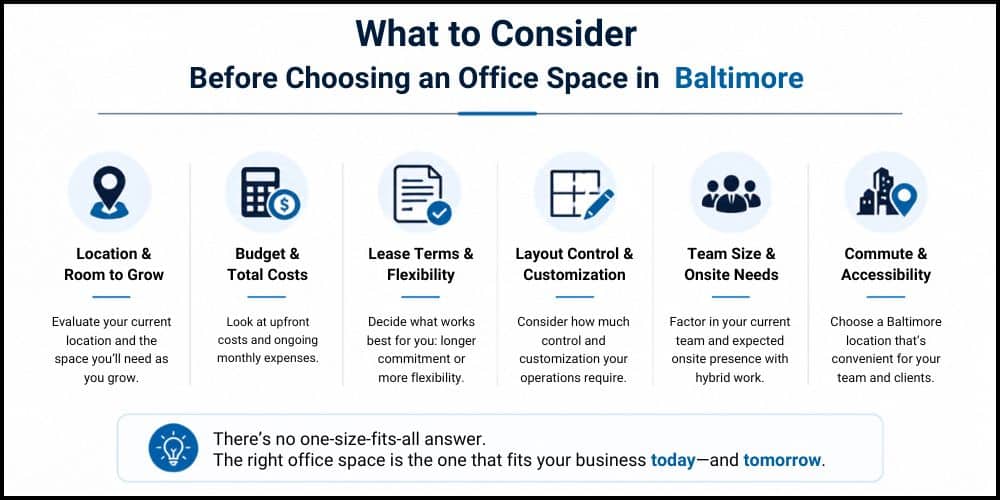
So the real question isn’t “which one is better”, it’s “which one fits your business right now.” Before you can answer that, it helps to think honestly about a few things:
- Your current business location and how much room you have to grow into
- Your available budget, including upfront costs and ongoing monthly office costs
- How comfortable you are with longer lease terms versus the appeal of more lease flexibility
- How much customization and control over office layout actually matters to your operations
- Your real team size today, and how many people will be onsite once you factor in hybrid work and remote teams
- Which part of Baltimore makes the most sense for employee commute times and client accessibility
There’s no universally correct answer here. What follows is a full breakdown of both models, so you can weigh them against your own situation instead of someone else’s.
What Is Flexible Office Space?
Flexible office space is an umbrella term, and it’s broader than most people assume. It covers everything from an open coworking desk to a fully private, serviced office suite,the common thread isn’t the layout, it’s the terms. Instead of signing a traditional office lease and spending weeks furnishing and wiring the space yourself, a flexible office arrangement often means paying a monthly rate for a move-in-ready workspace with some services and amenities included.
This model exists because businesses’ needs have gotten less predictable. A five;person startup today might be a twenty;person company next year, or it might not exist in its current form at all. A flexible workspace is built around that uncertainty rather than fighting against it.
In practice, a flexible arrangement typically includes:
- Shorter commitments, a short;term office space setup, often month;to;month or under a year, instead of a multi;year lock;in
- A genuinely move;in ready office, with desks, chairs, and infrastructure already in place, cutting out weeks of setup time and office setup costs
- Access to shared workspace amenities like a conference room or meeting space that you’d otherwise have to build and maintain yourself
- The ability to scale your footprint up or down as your team size and workspace requirements shift
- Utilities, internet, and sometimes cleaning or maintenance bundled directly into the monthly rate, so there’s one bill instead of five
One distinction worth making clearly: shared office space is only one flavor of flexible workspace. The category also includes flexible private office space, fully serviced office space, and managed offices where you get a private, lockable room but still benefit from the shorter terms and included amenities. “Flexible” describes the lease structure, not necessarily the layout; plenty of businesses get total privacy and total flexibility at the same time.
What Is Traditional Office Space?
Traditional office space is the model most people picture when they hear “commercial lease.” You rent a dedicated unit or floor directly from a landlord under a traditional office lease, typically for a period measured in years rather than months, and you take on responsibility for turning that space into a working office.
That responsibility cuts both ways. It’s more work upfront, but it also comes with a level of control that flexible arrangements generally don’t offer.
Traditional leases usually mean:
- Longer lease terms, often spanning three, five, or even ten years
- Full control over office layout, interior design, and branding throughout the space
- Tenant responsibility for office furniture, technology setup, and any buildout
- Separate management of utilities, maintenance, and other operating costs rather than one bundled rate
- A private workspace with a permanent, dedicated footprint that’s entirely your own
If you’re leaning toward this route, it’s worth reading through what actually matters before signing an office lease in Baltimore, because the costly surprises in long-term office costs can extend beyond the advertised rent, so it’s important to review maintenance responsibilities, renewal terms, operating expenses, and buildout allowances before signing.
Flexible Office Space vs. Traditional Office Space: Key Differences
Sometimes the fastest way to see how two options stack up is side by side. Here’s how flexible office space and traditional office space compare across the factors that actually drive most leasing decisions.
| Factor | Flexible Office Space | Traditional Office Space |
| Lease commitment | Short;term office space, usually adaptable | Long;term office lease |
| Setup | Move;in ready office | May require furniture and buildout |
| Upfront costs | Generally lower | Can be higher |
| Lease flexibility | High | Lower |
| Scalability | Easier to expand or reduce | More difficult during a fixed lease |
| Customization | Limited to moderate | Greater control over office layout |
| Utilities/amenities | Often bundled | Usually managed separately |
| Office furniture | Often included | Usually tenant;provided |
| Privacy | Depends on shared vs. private workspace | Generally higher |
| Best suited for | Startups, growing businesses, hybrid teams | Established businesses seeking stability |
| Long;term control | Lower | Higher |
Almost every question a Baltimore business owner asks about this decision traces back to one row on this table. If speed and adaptability matter most, the left column wins. If control and permanence matter most, the right column does. Most businesses land somewhere in between, which is exactly why it’s worth reading the rest of this guide before deciding.
Flexible Office Space: Advantages and Limitations
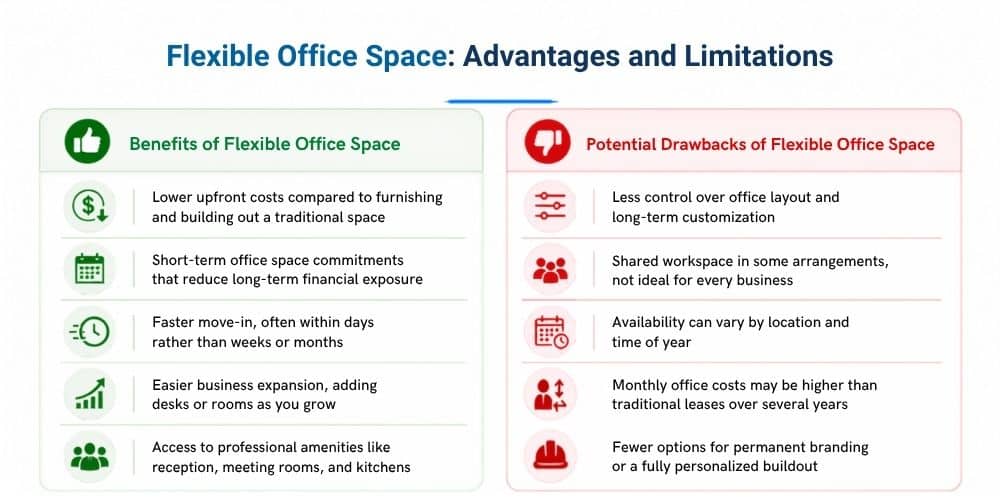
Benefits of Flexible Office Space
A flexible workspace has earned its popularity, especially with businesses that need to move fast without tying up capital they might need elsewhere. This is where office space for startups and office space for growing businesses tends to shine.
- Lower upfront costs compared to furnishing and building out a traditional space from scratch
- Short;term office space commitments that reduce long;term financial exposure if plans change
- Faster move;in, often within days rather than the weeks or months a buildout can take
- Easier business expansion, since adding desks or a second room doesn’t require renegotiating an entire lease
- Access to professional office amenities, reception areas, meeting rooms, kitchens — without the overhead of managing them yourself
Potential Drawbacks of Flexible Office Space
It would be misleading to present flexible space as the obvious winner in every case. The value depends heavily on how long you’ll actually occupy it and how intensively you’ll use it.
- Less control over office layout and long;term customization
- Shared workspace in some arrangements, which doesn’t suit every type of business or client meeting
- Availability can vary by location and time of year, especially for in;demand buildings
- Monthly office costs may end up higher than a comparable traditional lease if you stay for several years
- Fewer options for permanent branding or a fully personalized buildout
Traditional Office Space: Advantages and Limitations
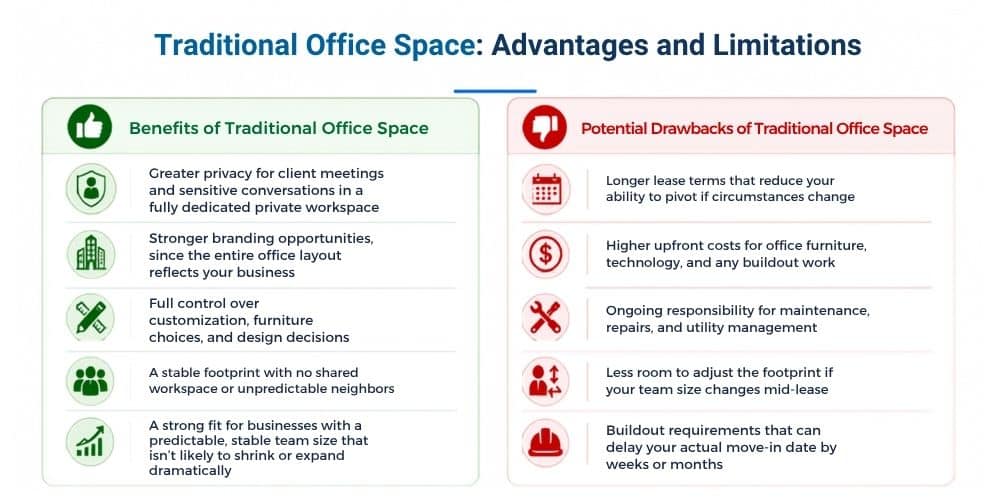
Benefits of Traditional Office Space
For a business that knows exactly what it needs and plans to stay put, a traditional office lease hasn’t lost any of its advantages.
- Greater privacy for client meetings and sensitive conversations in a fully dedicated private workspace
- Stronger branding opportunities, since the entire office layout reflects your business rather than a shared building’s aesthetic
- Full control over customization, furniture choices, and design decisions
- A stable footprint with no shared workspace or unpredictable neighbors
- A strong fit for businesses with a predictable, stable team size that isn’t likely to shrink or expand dramatically
Potential Drawbacks of Traditional Office Space
None of this comes free, and it’s worth going in with clear expectations.
- Longer lease terms that reduce your ability to pivot if circumstances change
- Higher upfront costs for office furniture, technology, and any buildout work
- Ongoing responsibility for maintenance, repairs, and utility management
- Less room to adjust the footprint if your team size changes mid;lease
- Buildout requirements that can delay your actual move;in date by weeks or months
Which Office Space Is Better for Different Types of Baltimore Businesses?
Flexible Office Space May Work Well For:
- Office space for startups and early;stage companies still finding their footing
- Office space for small businesses operating on tight, carefully managed budgets
- Office space for growing businesses whose workspace requirements shift every few quarters
- Office space for hybrid teams that don’t need a full;time footprint every day of the week
- Consultants and independent professionals testing out a new business location before committing further
Traditional Office Space May Work Better For:
- Established companies with a stable team size and predictable year;over;year headcount
- Organizations that need highly customized office layouts for specialized work
- Businesses that require a dedicated, private workspace for regular client visits
- Companies planning to stay in one business location for several years or more
- Teams that place a high value on full control over branding and interior design
What Should Baltimore Businesses Consider Before Choosing an Office?
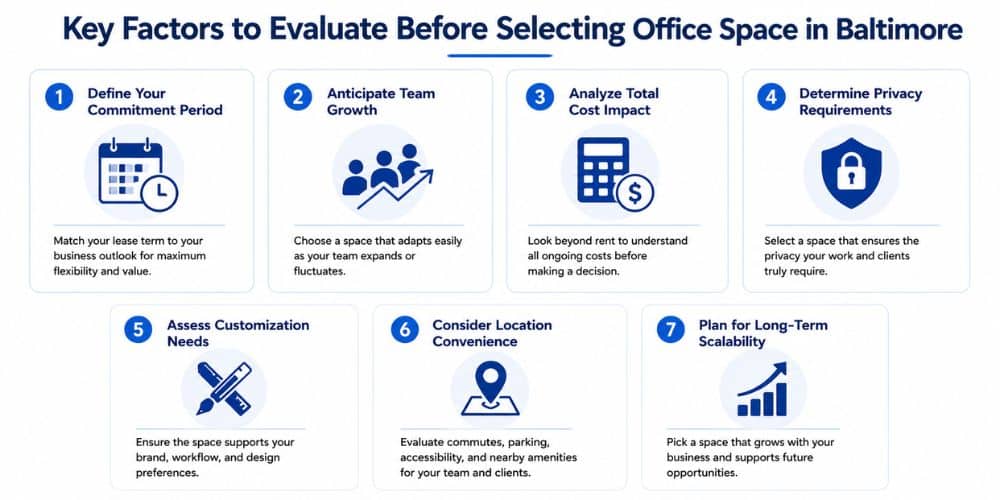
1. How Long Do You Expect to Stay?
This is usually the first question worth answering honestly, because it shapes almost every decision after it. A short;term outlook; six months to a year, or genuine uncertainty about growth tends to favor a short;term office space. A confident multi;year plan tends to favor a long;term office lease, where the extra commitment often comes with better per;square;foot value. It’s worth comparing short-term-vs-long-term-office space directly before assuming either option is automatically the safer bet; the “safe” choice depends entirely on how confident you are in your own timeline.
2. How Quickly Is Your Team Growing?
- Rapid hiring can strain a fixed traditional footprint faster than most businesses expect
- A flexible workspace makes it easier to add desks or an adjoining room without renegotiating an entire lease
- Predictable, stable team size reduces the risk that usually comes with long;term office leases
- Seasonal fluctuations in staffing may call for a hybrid work approach rather than a full;time office either way
- Realistic growth projections, not just optimistic ones, should shape the lease terms you ultimately choose
3. What Is Your Total Occupancy Cost?
Rent alone almost never tells the full story. The number on a listing is a starting point, not the total cost of running your business out of that space.
- Utilities, internet, and ongoing maintenance
- Office furniture and any technology setup you’ll need on day one
- Insurance and parking, which are easy to forget until the first invoice arrives
- Shared workspace or meeting space fees, if they’re billed separately
- Office setup costs and buildout expenses where applicable
Add all of that up before comparing two spaces on rent alone; a slightly higher monthly rate that includes utilities and furniture can easily beat a lower rate that doesn’t.
4. How Much Privacy Does Your Business Need?
Privacy matters more for some businesses than others. Law firms, healthcare practices, financial consultants, and other client-facing businesses handling sensitive conversations, and any client facing a company handling sensitive conversations tend to need more than an open floor plan can offer. If a private workspace is a genuine requirement rather than a nice;to;have, it’s worth understanding how a private office setup differs from a shared floor before signing anything, since the two experiences can be very different even within the same building.
5. How Important Is Customization?
- Branding that carries through the entire office layout, not just the lobby
- Custom layouts built around specific workflows, like a design studio needing open bench space
- A dedicated conference room or meeting space that’s always available, not booked by other tenants
- Long;term investment in interior design that reflects your company’s identity
- Full control over office furniture, fixtures, and finishes
6. Where Will Employees and Clients Travel From?
- Employee commute times and proximity to major routes or transit lines
- On;site or nearby parking availability, especially for client;facing businesses
- Realistic distance from where your team actually lives, not just where the office looks good on a map
- Client accessibility and visibility from the street or a main corridor
- Nearby amenities like dining and banking that make the workday easier for everyone
7. Does Space Support Future Growth?
This ties directly back to scalability and business expansion. An office that fits perfectly today but caps your growth in twelve months isn’t actually solving your problem, it’s just delaying it. Before locking in a decision either way, it’s worth working through a step;by;step framework for evaluating an office location in Baltimore that accounts for where your business is headed, not just where it stands today.
Which Office Model Makes More Financial Sense for Your Business?
There’s no absolute answer here, and anyone who tells you flexible space is always cheaper — or that traditional leases always offer better value — is oversimplifying. It comes down to total occupancy cost measured against how long and how intensively you’ll use the space.
A flexible office lease can make more sense when:
- The business needs space quickly and can’t wait on a lengthy buildout
- Team size is uncertain or expected to change within the next year
- Upfront costs need to stay low to preserve cash for other priorities
- Bundled amenities reduce administrative overhead and simplify budgeting
- A short;term office space better matches the business’s actual planning horizon
A traditional office lease can make more sense when:
- Long;term occupancy is genuinely expected, not just hoped for
- Team size is predictable and unlikely to shift dramatically
- Customization and branding play a meaningful role in the business
- Greater control over office layout is a real operational priority, not just a preference
- The space will be highly utilized day to day, justifying the investment in buildout
How Hybrid Work Is Changing Baltimore Office Space Decisions
Hybrid work hasn’t just changed where people work; it’s changed how much office space businesses actually need and how they think about using it.
- Required square footage often shrinks once remote teams aren’t all in the office at the same time
- Private workspace demand shifts toward smaller, more efficient footprints instead of one desk per employee
- Meeting space demand increases relative to individual desk space, since collaboration days matter more than daily desk occupancy
- Employee attendance patterns become less predictable week to week, making rigid, oversized offices harder to justify
- Overall workspace utilization becomes a bigger factor in lease terms, pushing more businesses toward flexibility
This shift is exactly why more Baltimore companies are looking closely at what a flexible, private office setup looks like in practice instead of committing to a full traditional office lease that sits mostly empty three or four days a week.
Baltimore Office Space Options for Different Business Needs
This is where The Mt. Washington Group’s own available office spaces can provide options for businesses with different workspace needs.
4301 Kenshaw Avenue is located in Northwest Baltimore, near the Baltimore City/County line, with convenient access to I-695 and the Reisterstown Station area. Rent here includes internet, electricity, and water, and the location is just minutes from Reisterstown Road Plaza’s banks, shops, and restaurants; a practical private office space option for a business that wants genuine convenience without sitting in the middle of downtown traffic every morning.
4813 Seton Drive is part of our broader Baltimore office space portfolio, situated in the Reisterstown Station neighborhood, and reflects the kind of accessible, efficiently laid;out professional environment we manage for businesses at different stages of growth.
5906 Park Heights Avenue and 6810 Park Heights Avenue round out our Upper Park Heights and Cross Country office locations, both areas with solid access to bus lines, nearby shopping centers, and the rest of Northwest Baltimore.
Availability and exact configurations shift over time as businesses move in and out, so the most reliable way to see what’s currently open is to check our commercial real estate for rent in Baltimore listings directly.
How to Find the Right Office Space in Baltimore
Narrowing down the right Baltimore office space is a lot more manageable when you work through it in order rather than reacting to whatever listing comes up first.
- Define your team size, both where it stands now and where it’s likely to be in a year or two.
- Decide how much actual workspace you need day-to-day, not just on your busiest day.
- Determine your preferred lease terms based on a realistic read of your business’s stability.
- List the office amenities that are genuinely non-negotiable for how your team works.
- Compare total occupancy costs across every option, not just the advertised monthly office cost.
- Consider employee commute and client accessibility from a few different directions in the city.
- Visit potential properties in person, photos rarely tell you how a space actually feels.
- Review lease flexibility and terms carefully, line by line, before signing anything.
The Mt. Washington Group can help businesses explore its available commercial office spaces in Baltimore based on workspace requirements, location, and day-to-day operational needs.
Flexible Office Space vs. Traditional Office Space: Which One Is Right for Your Baltimore Business?
Choose flexible office space if: your team is growing, your workspace requirements are likely to shift, or you want a faster, less complicated setup without tying up a large amount of capital upfront.
Consider traditional office space if your team size is stable, you’re confident you’ll stay for several years, and you place real value on controlling your own office layout and branding.
In the end, the right choice depends on your expected occupancy, your budget, your lease terms, and how your business actually operates day to day. There’s no universal answer that fits every company, only the answer that fits yours.
Frequently Asked Questions
Is flexible office space cheaper than traditional office space?
Not always. Flexible offices may reduce upfront costs, while traditional offices can be more cost effective for long term occupancy.
What is the difference between flexible and traditional office space?
Flexible offices offer greater lease flexibility and easier setup, while traditional offices provide more control, privacy, and customization.
Who is flexible office space best for?
It is often suitable for startups, small businesses, growing companies, and hybrid teams with changing workspace needs.
Is flexible office space good for small businesses?
Yes. It can provide professional workspace without requiring a large long term commitment.
What are the disadvantages of flexible office space?
Potential drawbacks include limited customization, shared facilities, availability restrictions, and higher costs for long term use.
Is a traditional office better for established businesses?
It can be, especially when a business has a stable team and wants greater control over its workspace.
Can flexible office space accommodate growing teams?
Yes, depending on availability and the property’s ability to provide additional space as the business grows.
What should I consider before renting office space in Baltimore?
Consider location, rent, lease terms, parking, amenities, commute, privacy, and future space requirements.
What amenities should Baltimore office space include?
Useful amenities can include reliable internet, conference rooms, furniture, utilities, secure access, parking, and maintenance.
How long should a business lease office space?
Choose a lease term based on your business stability, expected growth, budget, and anticipated length of occupancy.