
So the letter finally came. You’re approved for a Housing Choice Voucher, and for a minute it feels like the hard part is over.
Then the questions start. How long do I have to find a place? What’s an RFTA? Who pays the deposit? Can I just move in once the landlord says yes?
If that sounds familiar, you’re in good company. For many voucher holders, the next few weeks can bring new questions about finding a home, completing paperwork, and getting ready to move. This guide walks you through every stage, from the day your voucher arrives to your first night in your new home, in plain language and with real-life examples along the way.
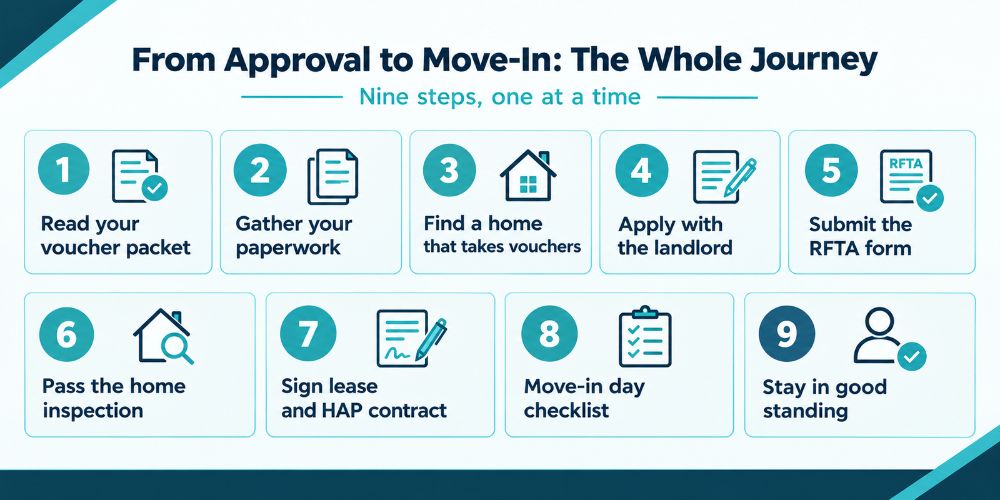
First, a Quick Look at How a Voucher Works
The Housing Choice Voucher program, often called Section 8, is a federal program funded by HUD and run locally by housing authorities. If you’re renting in Baltimore City, that’s the Housing Authority of Baltimore City (HABC). Baltimore County has its own housing office.
Here’s the part people love: you get to choose where you live. You’re not handed an address. You can search for an apartment, townhouse, or house that meets your household’s needs and the housing authority’s requirements. The unit must meet program standards, and the landlord must complete the required approval process.
As for the money, here’s the simple version. You pay roughly 30% of your adjusted monthly income toward rent and utilities, and the housing authority covers the rest, up to a limit called the payment standard.
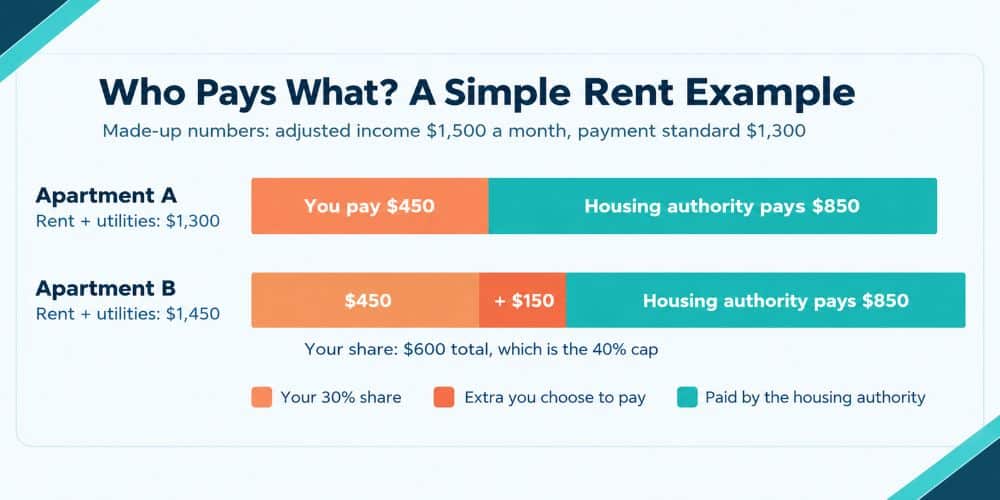
A quick example (the numbers are made up, just to show how it works):
Say your adjusted monthly income is $1,500. Thirty percent of that is $450. If the apartment’s rent plus utilities comes to $1,300 and that matches your payment standard, you pay $450 and the housing authority pays the other $850.
If the rent and utilities are higher than the housing authority’s payment standard, you may need to pay more out of pocket. However, your actual share depends on factors such as your income, utility allowance, and the approved rent. When you first lease a unit, your family’s share generally cannot exceed 40% of your adjusted monthly income if the gross rent exceeds the payment standard. Go any higher, and the housing authority won’t approve it.
Want to see how your own numbers might work out? Our guide on how Section 8 rent is calculated goes into more detail.
Step 1: Read Your Voucher Packet
We know it’s a lot of paper. But a few details in that packet will save you a lot of stress later:
- Your bedroom size. It’s based on your household, and it decides how much help you can get.
- Your expiration date. HUD requires the search period to be at least 60 days. Some housing authorities give you longer. Your voucher shows your exact deadline.
- The extension rules. If your search isn’t going well, ask your caseworker about extensions early, not on the last day.
- The RFTA form. You’ll hand this to the landlord you choose. More on it in Step 5.
Here’s a small habit that helps. Put your expiration date in your phone right now, with reminders at 30, 14, and 7 days before. Setting these reminders can help you stay aware of important deadlines and give you time to request an extension if needed.
Step 2: Get Your Paperwork Ready Before You Start Looking
Good apartments don’t sit around for long, and landlords like applicants who are ready to go. Before you tour anything, put these in one folder (paper or on your phone):
- Your voucher and packet
- Photo ID for every adult in the household
- Recent pay stubs or benefit letters
- Names and numbers for past landlords
- Your caseworker’s name and phone number
Think of Jasmine, a made-up example. She toured a townhouse on Saturday morning and had her documents on her phone. She applied before lunch. Another family saw the same place that afternoon, but they had to go home and look for their paperwork. Small thing, big difference.
Step 3: Find a Home That Takes Vouchers
This is the step that worries people most, but the law is on your side.
Maryland’s HOME Act, passed in 2020, made “source of income” a protected category in the state’s fair housing law, and that includes housing vouchers. In plain words, a landlord can’t turn you down just because you pay with a voucher. You can see the legislation on the Maryland General Assembly website. The Maryland Supreme Court has backed this up too. It found a landlord in violation for rejecting a voucher holder over an income requirement, as WMAR reported.
That said, finding the right place still takes some legwork. A few things that help:
- Start with landlords who already welcome vouchers. It saves everyone time.
- Search by exact phrases like “apartments that accept Section 8 in Baltimore,” and filter for your bedroom size.
- Visit in person if you can. Check that the locks work, the heat turns on, the faucets don’t leak, and there are no signs of mold or pests.
- Ask one simple question up front: “Have you worked with the housing authority before?”
These guides can point you in the right direction:
- how to find landlords who accept Section 8 vouchers in Baltimore
- our Section 8 apartments and homes for rent, voucher-friendly listings managed by The Mount Washington Group
One safety note. Scammers know that people searching for housing are under pressure. Say someone texts you a great listing and asks for $300 to “hold” it before you’ve seen it. That’s a red flag. Don’t send money or personal details to someone you haven’t met. Our post on how to avoid Section 8 housing scams shows you what to watch for.
Step 4: Apply and Get Approved by the Landlord
Once you find a place you like, you’ll fill out the landlord’s rental application. The voucher doesn’t replace it. Landlords can still review rental applications and apply lawful screening criteria, including rental history and permitted background checks. However, Maryland law provides additional protections for applicants using qualifying housing subsidies, including restrictions on certain income- and credit-based screening practices.
The biggest cause of delays? Simple mistakes. A skipped field, a missing pay stub, an old phone number. Take five extra minutes and double-check everything. Our post on common Section 8 application errors covers the usual slip-ups, and navigating the Section 8 application in Baltimore gives you a wider walkthrough.
Step 5: Turn In the Request for Tenancy Approval
The landlord said yes. Great! Now you need to tell the housing authority which home you chose, and that’s what the RFTA is for.
It’s a HUD form (HUD-52517) that lists the rent, the utilities, and some basic details about the unit. You and the landlord usually fill it out together. You can see the official form on HUD.gov.
Once it’s in, the housing authority will:
- Check that the rent is affordable for your household and reasonable compared with similar homes nearby.
- Schedule an inspection of the unit.
Here’s the key tip: turn it in early. Review and scheduling take time, and the timeline depends on your housing authority. If you hand it in the day before your voucher expires, you’re taking a big risk.
Step 6: The Home Inspection
Before housing assistance payments can begin, the unit must meet the applicable HUD inspection requirements. These standards help ensure the home is safe and suitable for occupancy. It sounds scary, but it’s really there to protect you. It confirms that the home is safe, clean, and in good repair.
The inspector typically looks at things like:
- Working smoke detectors and safe electrical outlets
- Heat, hot water, and plumbing
- Doors and windows that lock
- Leaks, peeling paint, and pests
- Safe stairs and railings
What if the place fails? It happens a lot, and it’s usually fixable. The landlord gets a chance to make repairs, and then the unit is checked again. A cracked window or a missing smoke detector is a common reason. The Housing Authority of Baltimore City (HABC) provides an HQS inspection checklist you can review ahead of time.
Please don’t move in early. Picture this: a family gets the keys a week before the inspection and starts unpacking. The unit then fails, and the repairs take three weeks. Because the housing authority hasn’t approved the home yet, they may end up owing the full rent for that stretch. It’s worth the wait.
Step 7: Sign the Lease and the HAP Contract
When the unit passes and the rent is approved, two agreements come together:
- Your lease with the landlord, usually for at least a year. It includes a HUD tenancy addendum that spells out program rules.
- The HAP contract. HAP stands for Housing Assistance Payments. It’s an agreement between the landlord and the housing authority about how the subsidy gets paid.
Read your lease before you sign, even if it’s long. Make sure you understand the monthly rent, your share, which utilities you pay for, the pet rules, and how to ask for repairs. If you’re not sure what to ask, here are 5 questions to ask before signing a lease in Baltimore.
And about the money: Housing Choice Vouchers generally do not cover security deposits. You may need to pay the deposit yourself, although local assistance programs may be available. Ask your housing authority about any additional support before signing the lease.
Step 8: Get Ready for Move-In Day
Keys are almost in your hand. Here’s a short list to run through:
- Set up your utilities, and ask your housing authority about your utility allowance
- Walk through the home with the landlord and point out any damage
- Take dated photos of every room, and keep a copy of the move-in condition report
- Update your address with your caseworker, your employer, the post office and your kids’ school
- Test the smoke detectors, and find the fuse box and the water shut-off
Those photos matter more than you’d think. Say you move out in two years and there’s a question about a stain on the carpet. Dated photos from day one settle it fast.
For a longer list, use our smooth move-In checklist for renters with vouchers. If this is your very first apartment, renting your first apartment in Baltimore is a good one to read next.
Step 9: Keep Your Voucher Healthy After You Move In
Moving in is a big moment, but it isn’t the finish line. To keep your assistance, remember to:
- Pay your share on time, every month.
- Follow your lease and take care of the home.
- Tell your housing authority about changes in income or in who lives with you. Don’t wait for them to find out.
- Show up for yearly recertifications and inspections.
- Be honest in every form. HUD lists fraud as a reason for losing assistance, and you can read more in its tenant obligations.
Think of it like this: if you get a new job and your income goes up, tell your caseworker right away. Your share may change a little, but that’s far better than a surprise later.
And if you ever need to relocate, our voucher transfer guide explains how to take your assistance with you.
From Voucher Approval to Move-In Day
Getting approved for a Housing Choice Voucher is an important first step, but finding a home involves several more stages. By understanding your deadlines, preparing documents, completing the approval process, and staying in touch with your housing authority, you can make the transition smoother. Take each step carefully and confirm requirements with your caseworker before moving in.
Quick Answers to Common Questions
How long do I have to find a home with my voucher?
HUD sets a minimum of 60 days, and your housing authority may give you more. Check the date on your voucher, and ask about extensions early.
Can I move in before the inspection?
No. The unit has to pass inspection and get approved first. Moving in early can leave you paying the full rent.
Does the voucher cover my security deposit?
Housing Choice Vouchers generally cover part of the monthly rent, not the security deposit. However, separate deposit assistance may be available through local programs.
Can a Maryland landlord say no because I have a voucher?
Maryland law generally prohibits landlords from rejecting applicants solely because they use a housing voucher. Landlords may still apply lawful screening criteria, subject to additional protections for qualifying subsidy applicants.
Can I use my voucher in another city or county?
Often, yes, through something called portability. The process differs between housing authorities, so talk to your caseworker before you start searching somewhere new.